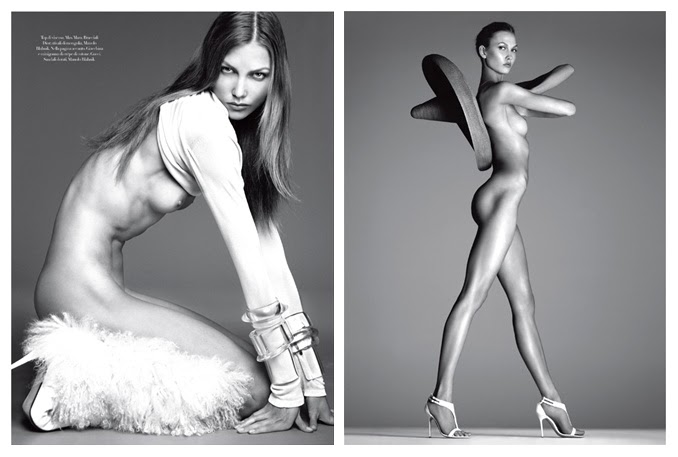
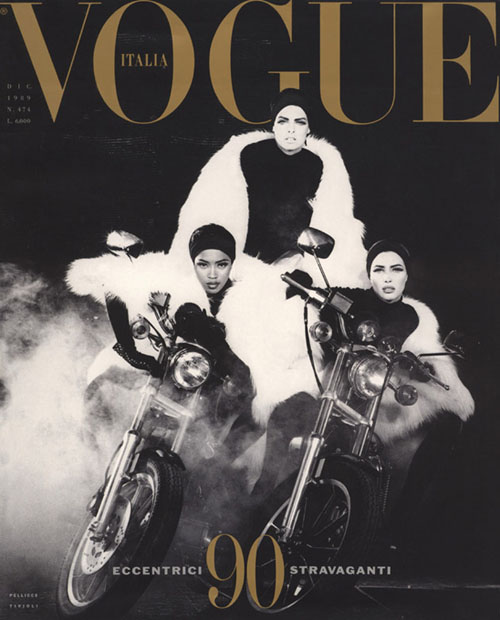
Franca Sozzani, has been editor-in-chief of Vogue Italia since 1988, shaping and changing the ideals and the rules of the fashion and publishing world.
Since the beginning of her career, Franca has been at the forefront of Fashion, making iconic stride after stride. She began her career at Vogue Bambini and since then has directed legendary publications including LEI, PER LUI, and Vogue Italia. Franca is also the author of several books, including 30 Years of Italian Vogue (1994), the curator of numerous exhibits and retrospectives and has been awarded several prizes for her contributions to art and culture.
Vogue Italia is recognized as the most arty and uncompromisingly, ‘Fashion,’ of the Vogues, and despite the fact that the editorial is in Italian, the magazine has become an international style bible. Franca has a genius for picking up on popular cultural trends and embracing these changes with ease, finding new and innovative ways to interact and connect with her audience. As the fashion publishing world evolves, so does the role of editors and Franca is leading the way in this unique and exciting development.
I’m sharing with you an amazing interview by Christopher Michael from Models.com, that gives further insight into the creative mastermind that is Franca Sozzani.
AN INTERVIEW BY ONE MGMT‘S CHRISTOPHER MICHAEL FOR MODELS.COM Christopher Michael: You have been the editor-in-chief of Italian Vogue since 1988. What sort of demands do you find yourself facing today that you did not have to deal with then?
Franca Sozzani: The fashion system has completely changed, so what was twenty-two years ago has nothing to do with today. Then, Italian Vogue was called the first experimental magazine. We didn’t even have so much sex in the beginning, but people were so conservative then that we were always dubbed the “experimental” magazine, and for the first two years, we suffered for this. Italian Vogue is an Italian magazine; it’s written in Italian, a language that is only spoken in Italy, so my idea was that in order to become international, we had to develop a visual language. At the time, photographers were appreciated, but not perceived as the artists or image-makers that they are today. Today, all magazines are hyper-visual—you buy any magazine and it’s one image after another. But we were the first magazine to prioritize the images—and this was, of course, before digital photography! Back then, we were always working on the lighting, and sending prints back and forth by Federal Express. Now you put images up on an FTP, and the next day you are already able to do the layout. Before computers, we did our layouts with tape and scissors. That seems like it was 200 years ago, but the big change has really been in the last ten or twelve years.
CM: Speaking of the visual language, another interesting choice you’ve made is the unprecedented ongoing relationship between Vogue Italia and Steven Meisel. It has to be asked, what reason was behind your decision to use one photographer for all of your covers for so long?
FS: I needed to have a consistent, recognizable look to every cover. My idea was that even if you took the word “Italia” off, you know what Vogue Italia is. Many magazines don’t seem to have a connection between one cover and the next, and it becomes hard to tell them apart. Especially today—images can be printed in such a high quality, but that also flattens them out, in a way. There’s a similar problem in fashion. Everyone can buy clothes—the most accessible clothes are not of the best quality, but unless you look at the label, you don’t know who it’s by. It’s this kind of over-saturation that makes me believe we are on the brink of another huge change.
CM: Italian Vogue, now more than ever, has really become a global brand. Do you believe that the time when markets were regional and separate is over? That we are becoming one global market?
FS: No. I believe that even today, there’s still an appreciation for the different system, or attitude, that each country has. What is surprising to me is how Vogue Italia is being appreciated in China, India, Korea, and Japan. This does not happen to every magazine. Sure, American Vogue has that, but they are an institution. Italy is not as powerful, but I think our international popularity goes back to your first question. The big difference between then and today is how much more conversant people are in visual language now. We can communicate because the language is no longer limited to words. It’s spoken in images.
CM: Due to economics, many publishers want their magazine editors to work within safer creative boundaries. Vogue Italia seems to have managed to continue allowing its photographers the same creative freedom. How have you managed to maintain that?
FS: Most of the photographers at Italian Vogue—Bruce Weber, Paolo Roversi, Peter Lindbergh—they started with me. We have a special relationship, because we all started together. Even with people like Tim Walker and Craig McDean— we’ve been working together for so long, and there is a trust that develops in that kind of working relationship. Condé Nast gives you freedom. If you don’t disappoint them while using that freedom, you are able to keep it, and I’ve been there for twenty-five years.
CM: You write on your own blog every day. What was the catalyst for starting it?
FS: When we started the website, I was sure that we could find a distinct language for the web, which was not the same as the magazine. What is the difference? In a monthly magazine, you have time to think about the images, to figure out how to make the layouts, and all of that. The web is exactly the opposite: it’s quick and it has to be out. I thought that if I were to do a blog, I would again take the responsibility for developing a voice, as I did with creating the visual language for the magazine. I thought I could make it about more than just fashion—it could be about television, news, scandal—but I would take responsibility for what I say on it. I don’t want to destroy the image of anyone, and I always try to stand by what I say. As a result of my work with fashion and photography, I have credibility with a certain audience, and I can use that to branch out into different subjects. It doesn’t mean that I don’t get attacked from time to time, but on a blog, you can have a dialogue with your critics. I think it’s very important to take responsibility for what you say. Whenever you do something publically, you will have critics— when I started at Vogue, people were always saying things. I like the opportunity to have dialogue, but first I have to expose myself and take the risk. It can be very tiring—I write six days a week. But the site has been successful, with over one million unique hits this month alone. It’s been great.
CM: Your approach to fashion goes beyond the clothes. It seems to be a very culturally aware, or even philosophical approach. Is this something you consciously cultivate? Or is that just the way you experience fashion?
FS: When we talk about fashion, we should have two different points of view. There are people who are very creative—they make fashion. And there are people who are really good with product—they make style. When someone is very creative, even if their work doesn’t sell, follow them. They are opening up a new way. When you are talking about style—or styling—it’s different. Anyone can do styling, and make a “correct” show. But a creative show relies on thousands of little ideas underneath the surface. It’s very important to see this difference. Because instead of focusing on one “fashion,” you focus instead on different women.You should not be provocative all the time, because if you are provocative all the time, people get tired of it. To be provocative every month means that you have to say the opposite of the issue from the month before. So you become unreliable. If you address the different kind of women that will always exist—the romantic, the chic, the perverse, the sexy—you encompass all of the fashion that you see. So I mix the two, the creatives and the people who are good with product, this brings something for each kind of woman; this is what I do.
CM: What is the selection process for you when it comes to introducing new photographers and stylists to the magazine?
FS: Instinct. I do, or I don’t. When we started the website, I almost did the whole thing with interns. There are so many young, talented people, who have a great energy, an interesting approach. They see things a different way. I meet people and if I like them, I hire them and it starts this way.
CM: When you were growing up and in school, is this what you always dreamed of doing?
FS: No. When I was in school I didn’t even think about working. I thought I would get married, have children. I was in university and really loved to study, I loved art and books. I was never a disco girl. I believe in fate, I guess—things just happen the way they are meant to.
CM: And your charity work with Child Priority?
FS: The charity and the young talent, these are two things that I spend a lot of time on. The young talent especially because I think that a new generation has to come; we can’t keep our seats forever. The more talented people there are around me, the less work there is for me to do because they are good. Young designers, young photographers, it’s good to have new blood, a new generation and they know that what I promise, I always maintain. I’m not interested in doing a contest where you win and you go home and make your mother’s day, but then nothing happens. I’m interested in a structure that provides young talent with opportunity so that they can do consulting and earn money. All of the people we’ve helped through the charity by providing job opportunities are still working in their fields six years later, and they made it through the economic crisis. You must be creative of course, but today you also need to have a sense of media, and be able to talk to people. You need to be able to make a business plan, and understand what is the focus of your line, of your work. It’s like having thousands of children and watching them grow up. It’s amazing, we put certain new designers who were selling in only a few cities on Yoox.com—and all of a sudden, they are able to reach shoppers in fifty different countries.
CM: I hate to ask such a banal question, but I feel I must—do you feel that the web threatens your print sales?
FS: Not at all. I believe the website is doing a great job because it functions as a teaser for the magazine. September, October, and November our sales were up twenty-seven percent, and this is because of the web. Everyone has this idea that online will kill print, but it’s not true. Like everything else, it depends on how you do things.